The Great Transition: A Mental Model for Everything Happening in AI Right Now

Ethan Mollick@ethanmollick
12 min read
The Short Version
"Daniel Miessler lays out ten simultaneous transitions reshaping technology, work, and society. From knowledge going public to ideal state management, here is a unified framework for making sense of the AI era."
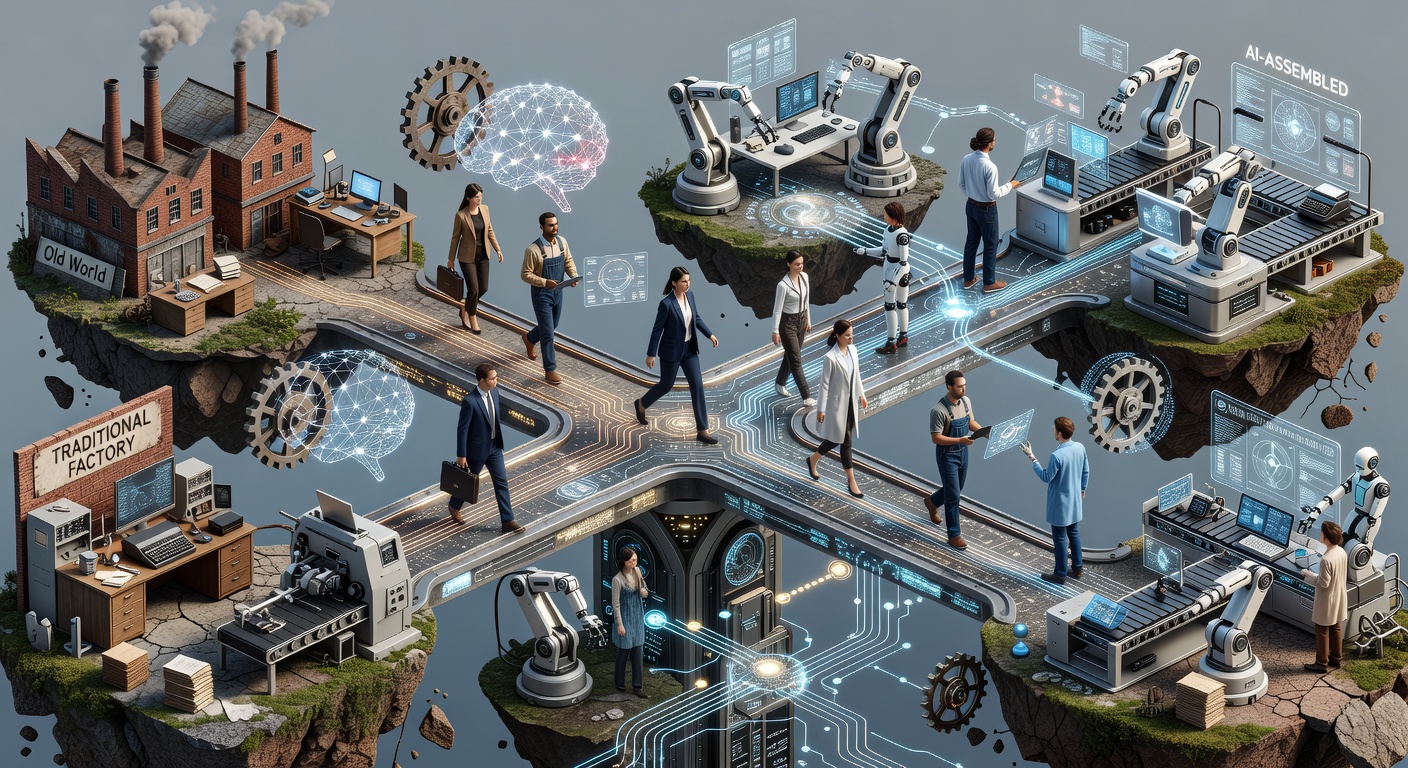
Daniel Miessler's latest video, The Great Transition, is one of the most cohesive attempts I've seen to wrap the chaos of 2026 into a single mental model. Rather than treating each AI development as an isolated event, Miessler identifies ten transitions happening simultaneously, all converging in the same direction. What follows is my breakdown of the key ideas, why they matter, and where I think he's right (and where the picture gets complicated).
The Ten Transitions
Miessler frames these not as predictions but as observable shifts already underway. The value is not in any single one. It is in seeing them as a unified movement.
1. Knowledge Goes from Private to Public
The gap between what a specialist knows and what anyone can access is collapsing. LLMs have absorbed the internet's worth of knowledge, but the newer development is skills, folders of markdown files that capture specialized expertise and make it portable. Combine that with Chinese labs aggressively open-sourcing frontier techniques through projects like DeepSeek, and the result is clear: privatized knowledge is being diffused into the public domain at an accelerating rate.
This matters enormously for knowledge workers. The moat of "I know things you don't" is eroding. The new moat is the ability to apply judgment, context, and taste on top of widely available knowledge.
2. Products Become APIs
Miessler has been saying this since his 2016 book The Real Internet of Things: businesses become APIs. The evidence is now overwhelming. Every major product launch in 2026 leads with "here's the MCP" or "here's how your agents can call this." His line captures it perfectly: "If I have to open an app, I've already lost."
The implication for builders is stark. Your product's core value needs to be accessible programmatically. The UI becomes optional, a convenience layer rather than the product itself.
3. The Consumer Disappears
When your AI agent is the one browsing, comparing, and purchasing, the entire consumer funnel inverts. There is no website to impress, no landing page to optimize. Your agent checks a directory of rated services, picks the highest rated option matching your preferences, calls the API, and reports back. Done.
This is where things get interesting for AI tool directories. The curation layer, the ratings, the categorization, all of that becomes infrastructure that agents consume rather than humans browse. SEO shifts from attracting humans to attracting their agents.
4. Interface and SEO Die
Front ends are going away. Not the content, but the assumption that a human will consume it directly. Documentation, marketing pages, product interfaces will all be designed primarily for agent consumption. The interface between the user and their tools will be mediated by their personal AI, presented in whatever format that specific user prefers.
5. Enterprise Becomes a Graph of Operations
This is where Miessler's framework gets most compelling. Companies today do not have a single document that says "this is every task, every workflow, every SOP in our entire organization." AI is about to create that. The enterprise becomes a transparent, inspectable graph of algorithms. Software vendors can no longer sell based on steak dinners and relationships. They have to prove, against measured metrics on specific nodes in the graph, that their solution performs better.
6. Automation Goes from Helper to Replacement
The reframing here is important. Automation is not "helping employees do their jobs better." It is companies moving toward a natural state: doing all the work themselves. The washing machine metaphor lands well. If you can do the work yourself with machines, hiring humans to wash clothes by hand in the river is not fairness, it is inefficiency. Global knowledge worker compensation runs around $50 trillion per year. That is the number companies are trying to reduce.
7. Human 3.0: The Post-Corporate World
If companies shed most employees, what do people do? Miessler envisions a substrate where individuals broadcast their full capabilities, not just a resume but everything: skills, interests, reputation scores, availability. Your personal daemon advertises what you can do. Need a cat sitter? An EMT? A systems engineer for a six month project? The substrate matches supply and demand in real time, mediated by agents on both sides.
This is optimistic but compelling. It is more human than the current model of dreading Monday inside a hierarchy you did not choose. Whether the transition is smooth or brutal is the open question.
8. Cybersecurity Becomes AI vs. AI
Attackers will build world models of target companies faster than those companies build models of themselves. The defender's only chance is to have equally capable AI: constant monitoring, automated response, transparent workflow graphs where every decision point is visible. The game becomes your orchestration system versus theirs.
9. The Inversion: Industries Become Use Cases
Stop thinking "we have security, let us add AI." Start thinking "AI runs the graph of all operations, and some of those operations happen to be what we used to call security, or HR, or procurement." The company's graph of algorithms is the system. Industries are just labels we put on clusters of nodes within it.
10. Custom Everything and Ideal State Management
Every company and individual will eventually run custom software. This creates a fragmentation problem Robert Putnam warned about in Bowling Alone: when everyone has different tools, different feeds, different realities, shared experience dissolves.
The unifying thread across all ten transitions is what Miessler calls ideal state management. Define what perfect looks like. Measure where you are now. Close the gap continuously. This works for companies, for individuals trying to lose weight, for security programs, for a federation of planets. It is the universal algorithm: ideal state, current state, migration.
Why This Framework Matters
The value of Miessler's model is not prediction. It is pattern recognition. When the next major AI announcement drops, you should be able to place it into one of these ten transitions and say "yes, that fits." It reduces anxiety because it reduces surprise. The direction is visible even if the timing and specific winners are not.
What I find most useful is the emphasis on convergence. These are not ten separate trends. They are facets of a single shift: the move from ad hoc human management of complexity to systematic, AI-orchestrated, state-based management of everything. Every transition Miessler describes is a different angle on that same underlying movement.
For anyone building in the AI tools space, the practical takeaways are immediate. Ship APIs before UIs. Design for agent consumption. Rate and categorize relentlessly. Build systems that can articulate and measure their own ideal state. The companies and individuals that internalize this framework will navigate the next few years with significantly less friction than those still thinking in the old paradigm.
Watch the full video: The Great Transition by Daniel Miessler on Unsupervised Learning.
The AI briefing your feed algorithm won't show you
Weekly updates on cutting-edge models, breakthrough tools, and what matters for builders and buyers.
← Back to all briefingsMore from AI Briefing

Bridging the AI Adoption Gap for Smarter Workflows
The gap between AI's potential and its real use is massive, but professionals can bridge it to boost productivity and secure their future in work.


The UX Traps in AI Coding Tools That Developers Overlook
In the rush to adopt AI coding tools, developers often ignore UX flaws that lead to hidden costs and frustrations, as seen in recent trends with Cursor and Claude Code.

Cutting Through the Hype: AI Video Tools That Actually Deliver for Startups
Amid the buzz of AI video generators like Sora and Runway, startups need tools that work without the bloat. Discover which ones cut costs and deliver results.